Overview
Product: Voyager — a web app for currency and cross-border trade operations (Bank Saint Petersburg).
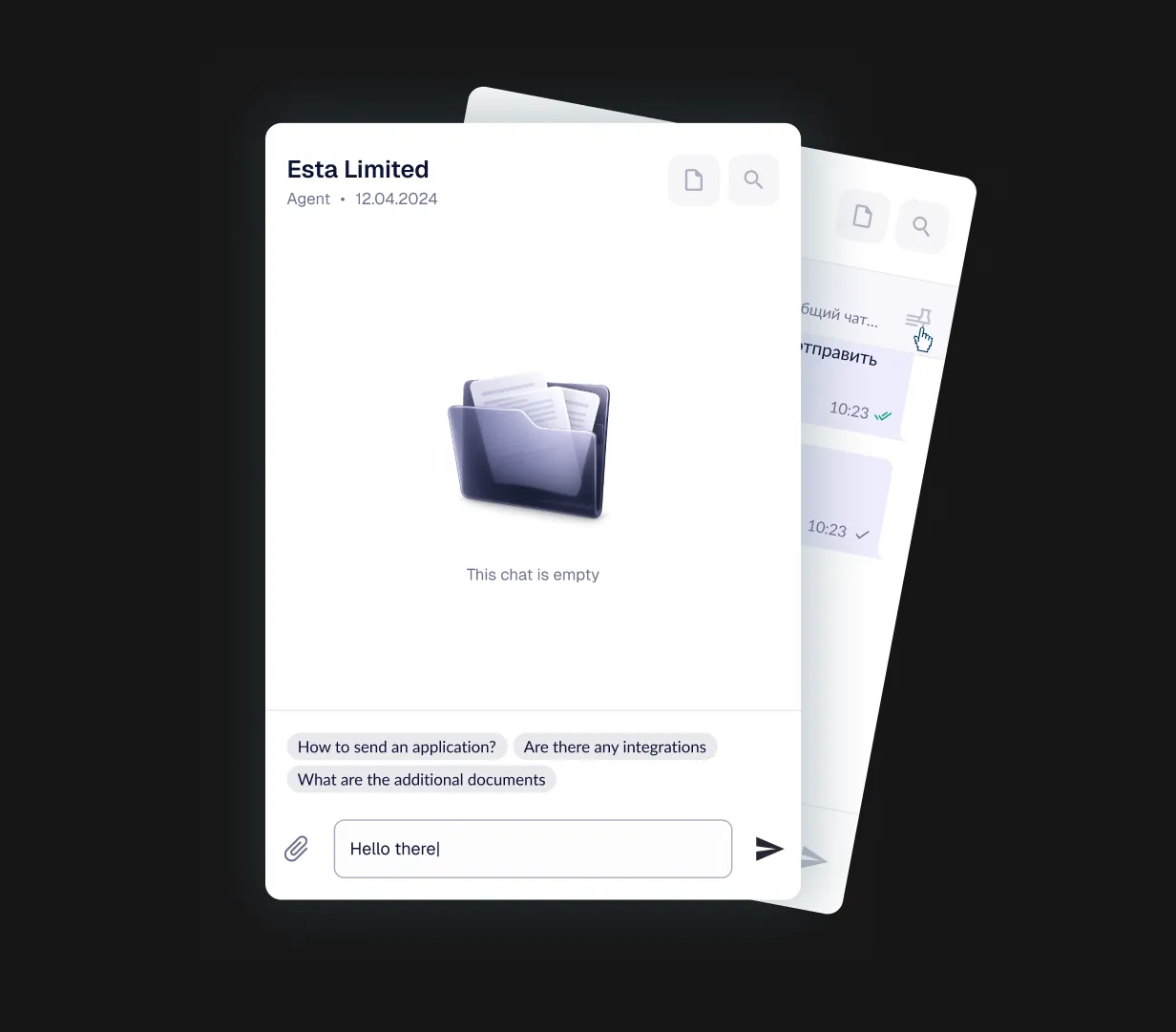
It started with one sentence from the business side: “We need a chat in export requests.” Two weeks of research later, it had turned into a different one: “We need a messaging system we can drop into any document in a sprint, not a quarter.”
The distance between those two sentences is what this case study is about.
The problem
I started with interviews and walkthroughs of real requests alongside currency control officers and client managers. The same picture came back from person to person.
The conversation was scattered across four channels. Email, phone, messengers, and occasionally a courier with paper. To find out where a request stood, someone would open the system, then their inbox, then hunt for the right email thread, then pick up the phone.
Context died in the handoff. When someone went on vacation, the history went with them. Their replacement would open a request, see the status “returned for revision,” and find no trace of why it was returned or what had already been discussed.
Clients were left guessing. A request sits there, no visible reason, and the only way to find out is to call support. A meaningful share of those calls weren’t problems at all — just “what’s happening with my request?”
Taken one at a time, each of these looks like a minor annoyance. Together they added up to days of delay on deals where delay costs real money.
The decision: module
The most important call I made on this project didn’t happen in Figma. It happened in a room with product and engineering.
I asked one question: where else, besides export requests, are people going to need to have this conversation? Everyone in the room answered immediately — import requests, contracts, deal passports, currency control. Basically everywhere.
That reframed the brief. We weren’t designing a screen. We were designing a component that would have to live in a dozen different contexts. Which bought us three things:
A new document type stops being a new project. Adding messaging to the next document became a configuration task instead of a full design → build → test cycle. This was the argument that won stakeholders over faster than any other: shipping the feature in the next section takes a fraction of the time.
One consistent experience across the product. A currency control officer works in requests and in contracts. If messaging behaves differently in each, they learn it twice and make mistakes twice as often. A single module removes that tax.
Predictability for engineering. One codebase instead of five near-identical implementations means fewer bugs and materially cheaper maintenance. In a bank, where a mistake inside a financial document is expensive, that’s a risk argument, not an aesthetic one.
“Modular system” sounds like an engineering decision. It was really a product one: invest once so you don’t have to invest five times.
Designing for competing roles
The hard part wasn’t technical. It was that a single request brings together people with very different permissions and very different goals — the client, the client manager, and the back office.
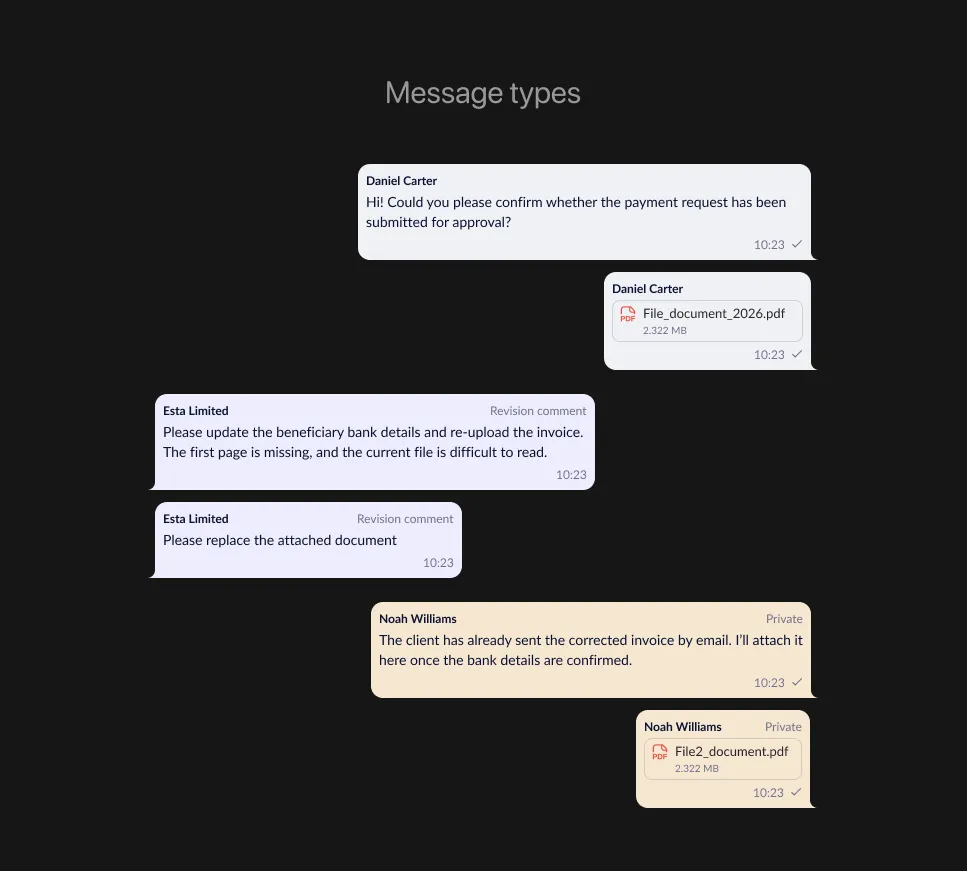
That’s where the defining piece of the interface came from: private messages. Staff can switch the composer into internal mode, and the message goes to an internal thread instead of to the client.
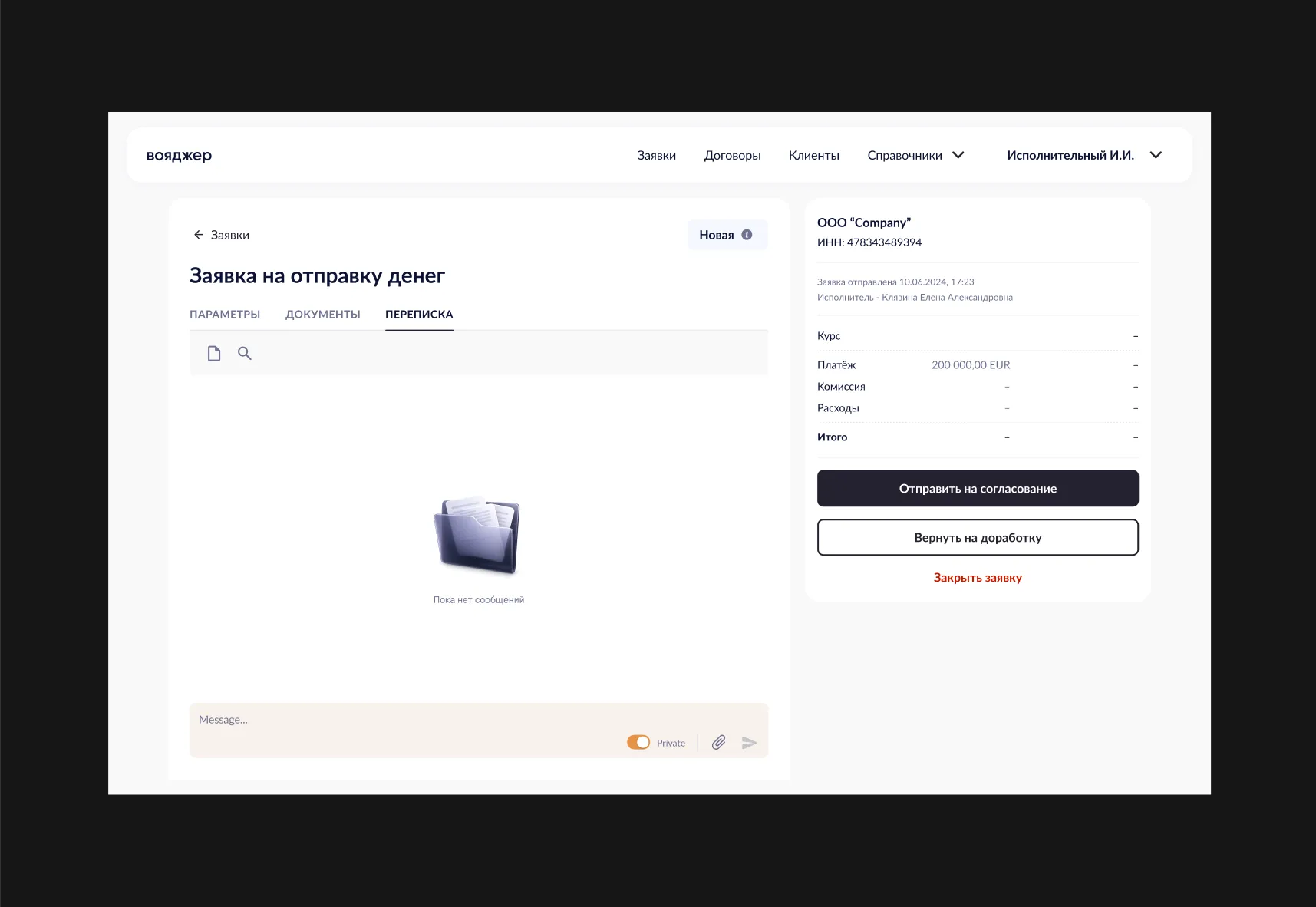
This is a place where design is really about the cost of a mistake. One private message accidentally sent to a client is a reputational incident, and sometimes a regulatory one. So privacy isn’t a checkbox tucked into a corner — flipping it changes the state of the entire composer: the background, the label, and the color of the outgoing message all shift. Missing it is close to impossible.
Everything else followed from how people actually work with these documents:
- Reply to a message — long threads on a single request lose the thread without quoting.
- Move a message to another request — the most “banking” feature here. Clients routinely write in the wrong place, and before this it meant retyping the whole exchange by hand.
- Pinning — bank details and agreed terms shouldn’t sink under a hundred messages.
- Tags and “mark as important” — fast navigation through long threads.
- Search — across text, file names, and tags, with its own flow for stepping through matches and a result counter.
- Attachments with previews, because 90% of this conversation is about documents.
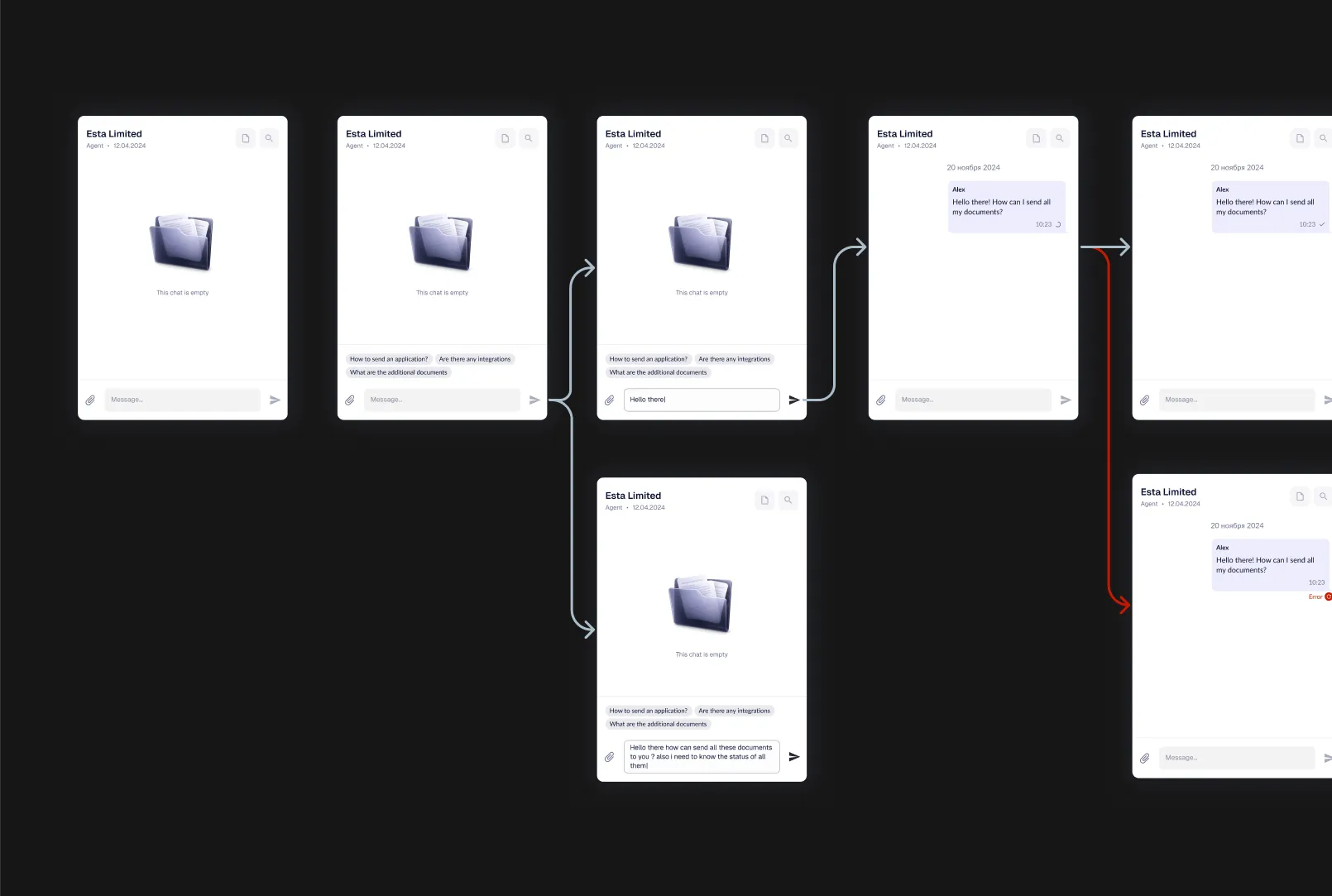
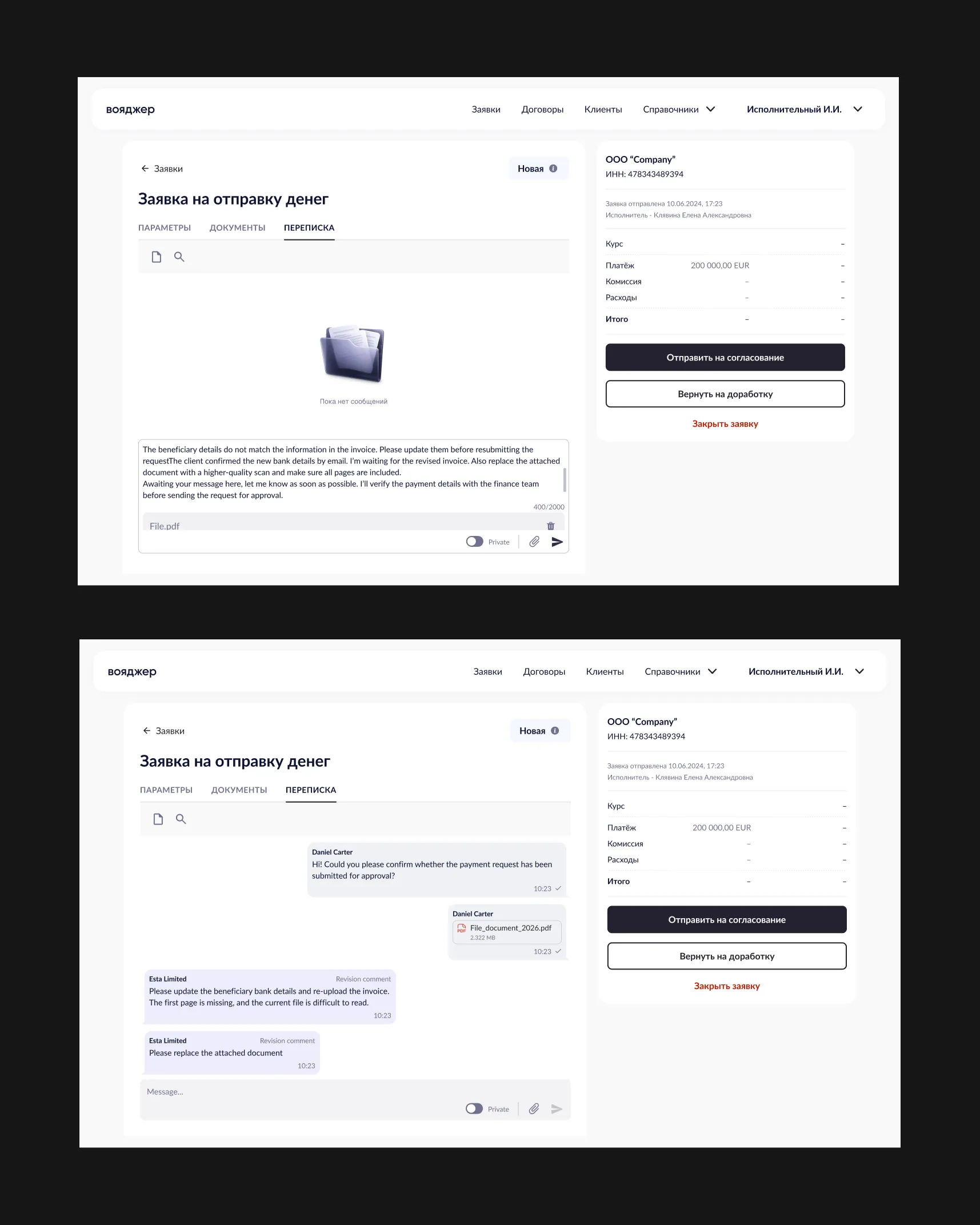
I worked every scenario down to its states: empty thread, sending, send failure, retry, long message, message with an attachment, search with no results.
Process
Research. I looked at how messaging is built into Tinkoff, Sber, and Alfa-Bank — and, more usefully, at how it works in operational tools where the conversation is attached to an object rather than to a person. The second group taught me more: bank chats are mostly support, and what we needed was a conversation around a document.
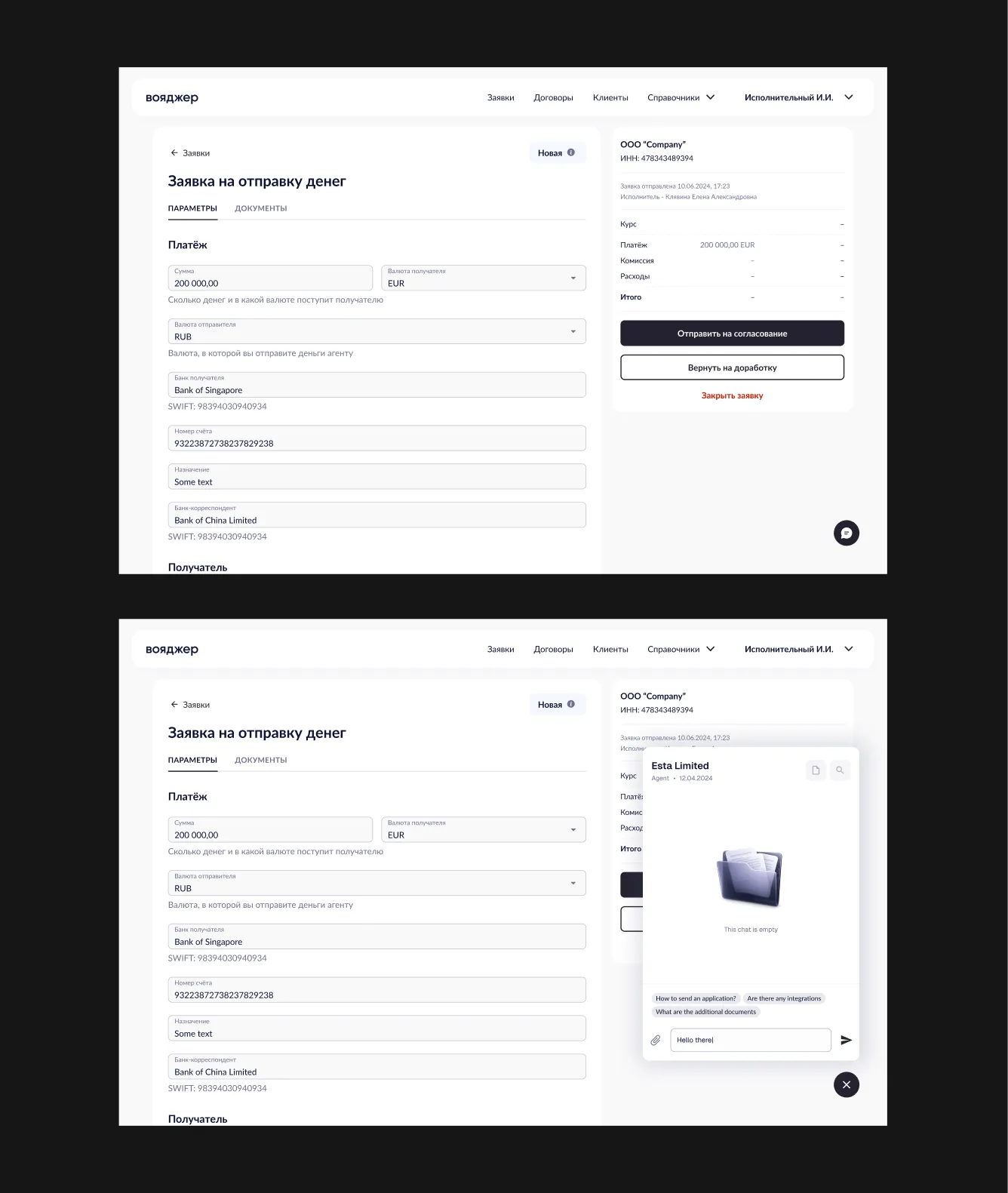
Concepts. Five integration approaches, from a full-screen tab to a floating widget. I took the two strongest into testing: a tab inside the request, and a widget overlay.
Validation. An interactive Figma prototype, tested with actual bank staff. The hybrid won: a full “Messages” tab inside the document, plus a compact widget for quick access elsewhere. Same module, two wrappers — exactly the thing modularity was for.
Design system. Twelve new components in total, with documentation and an integration guide for new sections — so the next team could ship messaging without me.
Results
- −40% time to resolve a question on a request. The conversation that used to run through email and phone calls now happens where the document is.
- −35% support calls about request status. Clients stopped calling just to find out what was going on.
- 78% of users used messaging in the first month. For a B2B tool with a conservative audience, that’s high — we never had to sell the feature internally.
- CSAT for the request handling process: 6.2 → 8.7.
Alongside those: completed request conversion +15%, staff processing speed +20%, unfinished requests −18%.
And the payoff modularity was built for: subsequent messaging scenarios in other sections shipped roughly 60% faster, with fewer bugs, because the components were already there.